Field Notes
By Jason Kumpf, Strategy Advisor · September 14, 2026
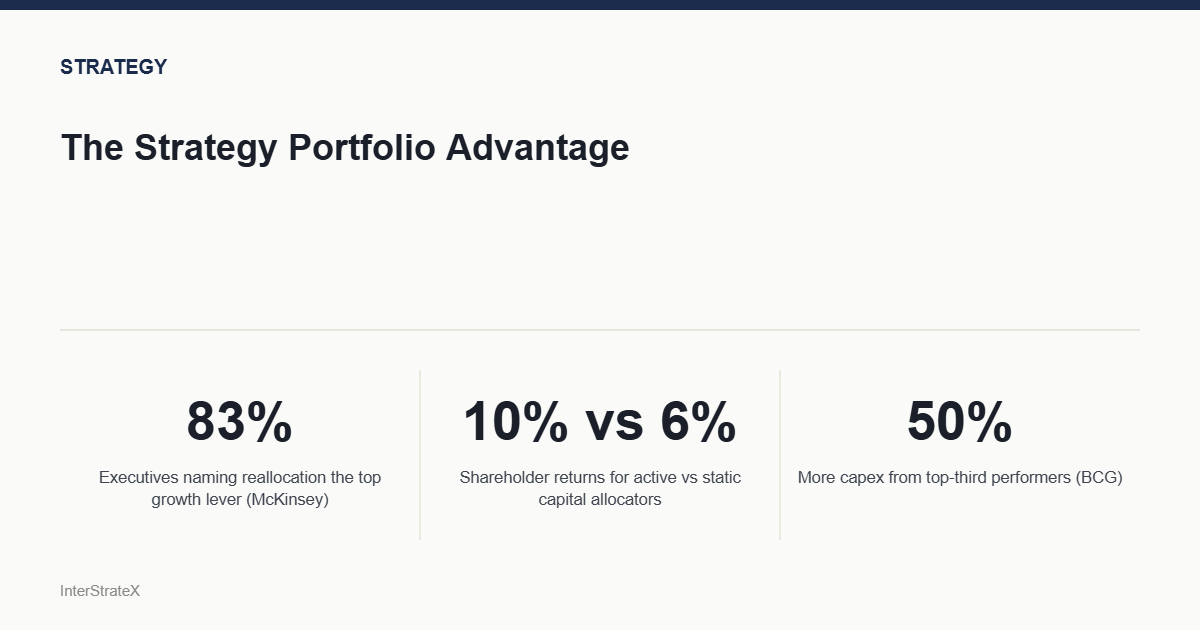
Every enterprise strategy review ends the same way: a list of priorities long enough to give every division a line item and short enough to fit on one slide. The two goals rarely align. Executives already know which outcome matters more. McKinsey has found that 83 percent of senior executives name actively shifting resources across a portfolio of businesses as the single most critical management lever for growth. Belief and behavior diverge from there. The same research found that one in three companies moves only 1 percent of its capital budget from one year to the next, and the average enterprise reallocates barely 8 percent, a rounding error against the size of most corporate portfolios.
That inertia carries a real cost, and it compounds. McKinsey's long-run analysis of corporate capital allocation found that companies which actively redirect resources toward their highest-return opportunities deliver an average total return to shareholders of 10 percent, compared with 6 percent for companies that hold their allocation steady year after year. Sustained over two decades, that four point gap compounds into roughly double the enterprise value. A modest annual difference, held constant across dozens of budget cycles, becomes the difference between a company that sets the pace in its category and one that keeps pace with it.
The mechanism behind the gap is straightforward. A company running twelve strategic priorities has effectively decided that nothing outranks anything else. Each initiative draws against the same finite capital, the same finite executive attention and the same finite frontline capacity. Spread twelve ways, a strategy rarely reaches full strength anywhere. Concentrate that same total resource base on three or four priorities and each one receives the scale of investment that actually changes outcomes: enough capital to reach a category-defining position, enough senior attention to clear genuine bottlenecks and enough operational focus to move at full speed rather than in fragments across successive budget cycles.
Boston Consulting Group's review of capital allocation across more than 10,000 public companies points to the same pattern from a separate angle. Firms in the top third of stock market valuation, measured against their industry peers, invested about 50 percent more in capital expenditure than the rest of the field. They did not spread that additional investment across a longer list of initiatives. They concentrated it, and the payoff showed up directly in the numbers: a return on assets about 55 percent higher and sales growth about 65 percent higher than their less concentrated peers. Investing more only pays off when the additional capital lands on the priorities equipped to use it well. A wide, thin portfolio can absorb a great deal of new investment without changing much of anything.
None of this argues for a smaller ambition or a narrower company. It argues for a different relationship between ambition and allocation. The enterprises that outperform are not the ones attempting less. They are the ones that decide, with discipline, which few initiatives merit the resources to succeed at real scale, then fund those initiatives as though the rest of the portfolio does not compete for the same dollar. That decision is uncomfortable, because it means pulling capital and attention away from initiatives that are entirely reasonable and simply not the highest-return use of a limited resource pool. Reasonable is not the bar for a strategy portfolio built to outperform. Highest return is the bar.
For most organizations, the limiting factor was never a shortage of good ideas. Every division can build a sound case for its own project. The real constraint is a portfolio review rigorous enough to rank those cases against each other and consistent enough to act on the ranking every year, not once at the start of a multi-year plan. Companies that treat resource reallocation as a recurring discipline, revisited with the same regularity as a financial close, build an advantage that compounds precisely because a wide field of diluted bets cannot match it. The advantage does not come from a larger budget. It comes from choosing, repeatedly, where the next dollar and the next hour of senior attention will do the most.
The strategy portfolio advantage is not a matter of having sharper ideas than the field. Most industries carry a fairly even distribution of good ideas. The advantage belongs to the organization willing to fund fewer of them fully, and to keep making that choice as conditions shift and new opportunities compete for the same finite pool. Focus is not a simplified version of strategy. It is the mechanism through which strategy actually converts into results, one allocation decision at a time.